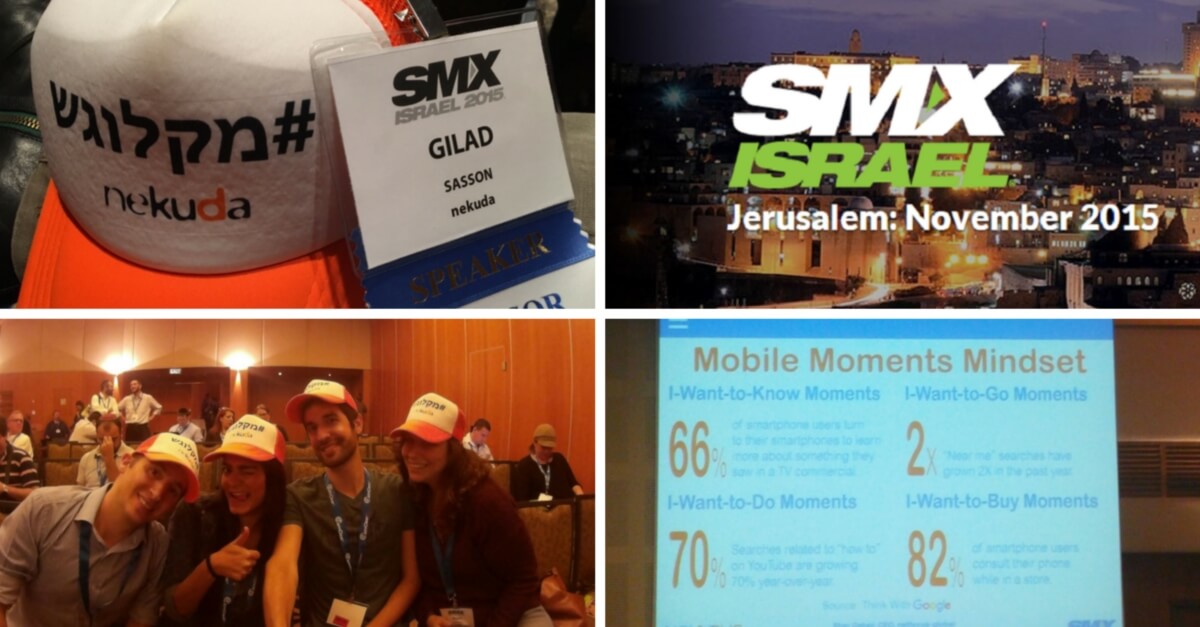
Best of SMX Israel 2013 – Search Marketing Expo Israel

SMX Israel 2013  (#SMX, #SMXisrael) was filled with information on the various sub-topics of search marketing:
SEO after Google’s algorithm changes, search and social media advertising, social media marketing and new topics that are expected to dominate the search marketing industry:
mobile SEO, semantic web and so on. Next we’ll try to summarize the most important things said in the various SMX Israel panels.

Link Building

Do’s

  • Follow incoming links (especially if the website has been penalized or notified by Google Webmaster Tools).
  • Use Google Disavow Link tool to remove unwanted or harmful incoming links, but be careful not to throw away precious links too.
  • Build legitimate links to return to the pre-penguin search engine positions.
  • Build links from various keywords and non-keywords terms (such as click here) and from long tail keywords.

Don’ts

  • Do not build footer links or place links on the footer.
  • Do not focus solely on short tail keywords anchors.


Something to think about

According to Jim Boykin of Internet Marketing Ninjas, the like, tweet or comment are the new link. So, if search engines used to see links as a sign of authority, now links are one gear in a system with different parts, most of them are social.

Content

Do’s

  • Create unique, quality automated content using graphs, diagrams and automatic news feeds.
  • Replace the keywords found in the keyword research with questions and provide them answers on the website content pages.
  • Consider the audio part of the videos.
  • Concentrate the main keywords and important links at the beginning of the video’s description paragraph.
  • Get inspired by foreign content to create original and fresh Hebrew content.

Don’ts

  • Don’t rule out automatic content.
  • Don’t create too long videos.
  • Don’t steal, duplicate or copy content.

Search Engine Advertising

Do’s

  • Create unique landing pages for each ad and separated campaigns for every target audience.
  • Use negative keywords to achieve quality and efficient website traffic.
  • Use Google remarketing tool.
  • Create custom reports on Google Analytics and track them regularly.

Don’ts

  • Don’t use broad keywords, they are expensive and ineffective.

Social Media Marketing

Do’s

  • Use Facebook various advertising possibilities and optimizing tools.

Don’ts

  • Don’t buy links – you’ll end up removing volunteering fans.
  • Don’t use clickjacking or other black hat SEO methods to increase the number of fans on your Facebook or Google+ page (though in some niches this use is pretty common).

Technical SEO

Do’s

  • Build a mobile website (WAP site), because the mobile market is constantly on the rise and building a cross-platform mobile site is a short process comparing to developing a mobile application.
  • Follow users’ behavior before deciding whether to build a WAP site or an application.
  • Join schema.org, markup structured data, add rel=”author” tag and any other act that will help search engines to better understand what the website is all about.
  • More technical SEO issues on Google’s John Mueller Q&A panel.


Another thing that happened in SMX Israel 2013 is the introduction of nekuda’s affiliate program,
which pays 5%-10% commission for every successful lead referred to our offices.

More SMX Israel photos:

Facebook - SMX Israel 2013 Pictures

Google+  - SMX Israel 2013 Pictures


It was fun seeing 500+ people getting to Jerusalem, See you all next year


Read more at:

The excellent summary by Itay Brenner  at Askpavel.co.il.

And the great elaborate sum up by Ronit Epstein at  3DoorDigital.

Bing new Webmaster Guidelines

Bing has published its first webmaster guidelines early this week. Bing Webmaster Guidelines stated purpose is to help websites to be found and indexed by the search engine crawler and they include technical recommendations, SEO guidelines and a list of activities to avoid.

These guidelines can be found on Bing Webmaster Help Center. Bing will also hold a series of webinars that will explore the guidelines topics. The webinar details and registration form are at: http://swrt.worktankseattle.com/series/95/seriessignup.aspx.

Bing vs. Google Webmaster Guidelines

Comparing to Google Webmaster Guidelines, Bing guidelines are less detailed, but they still cover the same topics more or less. Both Google and Bing emphasize the importance of website content that is unique and updated website content, which is also readable by the search engine crawling bots. Unlike Google, Bing do mention the explicit SEO word and note that “Search engine optimization is a valid practice which seeks to improve a website, making content easier to find and more relevant. “

Bing also mention social media role in search engine ranking. One of the activities they recommend avoiding is social media schemes and refer to automatic programs designed to artificially increase the number of fans or followers.

Bing recommends on building an inbound and outbound link plan. They suggest creating inbound links using social sites or simply by asking different sites for links. They highlight that paying for links is risky, but unlike Google, they do not detail the consequences and do not direct to a contact form that encourages webmaster to report about other webmaster unethical link building.

Google Updates Search Algorithm and Panda

Increasing diversity is a term you’d normally expect to see in relation to Higher Education but now Google is getting in on the act with its own attempts to spread diversity (presumably timed to coincide with the Jewish New Year…).

Quite apart from any effort to improve racial harmony, Google wants its search results to come from a more diverse range on domains and has issued an algorithm update to achieve this. The aim of the update is that users find a wider variety of sites when searching, rather than seeing a number of results from the same domain. Google’s Matt Cutts (via twitter) announced it thus:

“Just fyi, we rolled out a small algo change this week that improves the diversity of search results in terms of different domains returned.”

image: George Lu on Flickr

The diversity algorithm update was followed by a new Panda update which was announced 18th September. This was a minor update which according to Google was expected to impact only around 0.7% of searches.

Baidu to Rival Apple and Google with Mobile Web Browser

Baidu, the search engine which dominates market share in China, has announced plans to launch its own mobile web browser in an attempt to profit from the sale of advertising, web apps and content.

Baidu’s search engine, which will contend with Apple’s Safari and Google’s Chrome, claims to be 20% faster than its rivals. Other details announced to the press and reported on Search Engine Watch suggest that the user experience will follow Google’s lead in respect of web apps and enabling users to stream video without having to download additional software.

image: bfishadow

Officially, Baidu still maintains links with Yahoo but will now look to independently monetize its search engine traffic and develop other aspects to its operation, in part to avoid the business model of Mozilla whose revenues are heavily reliant on Google. Baidu’s web browser will be just one income stream in a wider revenue generation scheme.

Baidu is optimistic for the future hoping to have its web browser installed on 80% of China’s Android handsets by the end of the year. Chief Financial Officer Jennifer Li also announced plans to establish a cloud computing center at a cost of 10bn Yuan ($1.6bn).

Search Queries Alerts on Google Webmaster Tools

Google Webmaster Tools has announced adding a new feature: an alert function that will notify webmasters on significant changes in the search query data.

Google Webmaster Tools alerts function sets up automated messages to draw your attention to this or that issue. July saw the addition of a Crawl Error Alerts and as of yesterday Google have supplemented the package with Search Queries Alerts.

What this means in practice is that Google Webmaster Tools, which already monitors the impressions and clicks for your designated sites, will send you a message when a significant spike or drop occurs in either of these figures.

Google Webmaster Tools alert for example

Image: Official Google Webmaster Central Blog

This handy feature of Webmaster Tools saves time by drawing your attention to the anomalies as and when they occur. You should investigate the causes which might lie behind sudden changes in the impressions or clicks on your site as they happen, but when things are running as expected you don’t have to spend time monitoring figures which aren’t out of the ordinary.

Internet Solutions:

  • Web and Search Engine Marketing Solutions
  • Search Results Optimization (Paid and Organic)
  • Brand Management and Reputation Monitoring
  • Social Media Marketing, including SMO
  • Marketing Process Management and Assimilation
  • Target Oriented Marketing (Conversion)
  • Competition Research and Analysis

Social Media

    Follow us:

Quick Contact